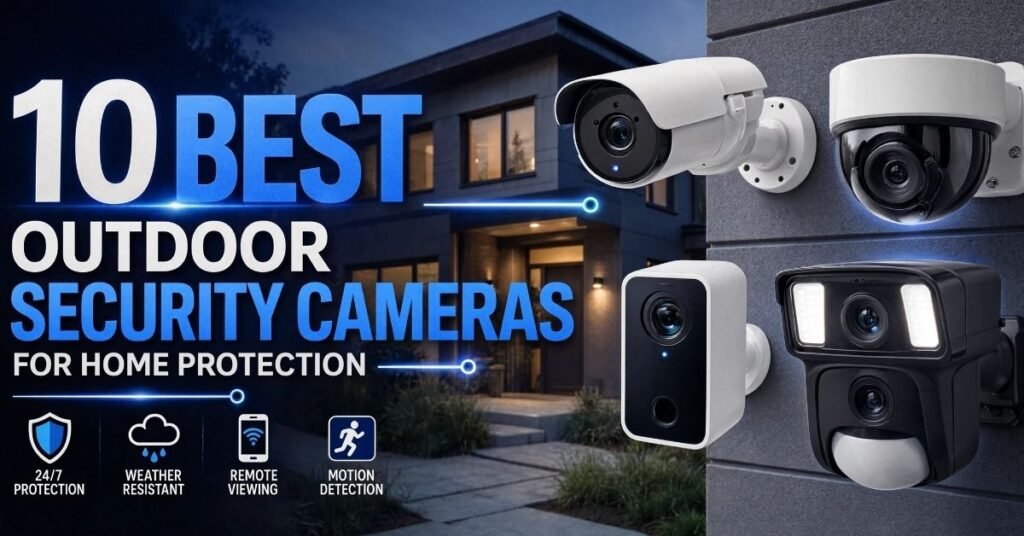

Choosing the right security camera can make your home feel safer and help you keep an eye on entrances, driveways, gardens, garages, and other outdoor areas. However, not every camera is designed for the same environment or security need. The Best Outdoor Security Cameras should offer a practical combination of reliable monitoring, suitable weather resistance, useful detection features, convenient installation, and clear viewing.
In this guide, we compare 10 outdoor camera options, including wireless models, spotlight cameras, pan-tilt designs, solar-powered options, and recognizable models from Tapo and Arlo. Because some of the supplied product names appear to be retailer-style names rather than complete manufacturer model numbers, specifications are only stated where they can be verified from manufacturer information.
Whether you need a camera for your front yard, driveway, backyard, garage entrance, or general outdoor surveillance, this guide will help you understand what to look for before buying.
What Makes a Good Outdoor Security Camera?
A good outdoor security camera needs to do more than simply record video. Outdoor environments expose cameras to rain, dust, sunlight, temperature changes, insects, and changing lighting conditions. A camera that performs well indoors may not be suitable outside.
Weather resistance is therefore one of the first things to consider. You should also look at video resolution, viewing angle, night vision, motion detection, connectivity, power source, storage options, and the camera’s installation requirements.
Features such as two-way audio, person detection, motion tracking, integrated spotlights, and sirens can also make an outdoor camera more useful. However, the importance of each feature depends on where you plan to install it.
For example, a driveway camera may benefit from a wide viewing angle and person detection, while a backyard camera may benefit more from pan-tilt coverage or motion tracking.
Quick Comparison of the 10 Cameras
| Camera | Best For | Camera Type | Key Consideration |
|---|---|---|---|
| Waterproof Spotlight | Outdoor illumination | Spotlight camera | Check exact weather-resistance rating |
| Wireless Detection Mic | Remote monitoring | Wireless camera | Verify audio/detection features |
| Tapo Outdoor Wireless | General outdoor monitoring | Wireless outdoor camera | Check exact Tapo model |
| Tracking Wireless | Moving subjects | Tracking camera | Confirm tracking method |
| Wireless Spotlight Cam | Nighttime monitoring | Spotlight camera | Check power and storage |
| Arlo Essential 2025 | Modern outdoor monitoring | Plug-in smart camera | 2K option, smart alerts |
| Tapo C500 Pan-Tilt | Wide-area monitoring | Pan-tilt Wi-Fi camera | 360° coverage and tracking |
| Arlo Essential Outdoor | Wire-free outdoor security | Battery camera | 2K/HD versions |
| INFIYA Solar Z1 | Reduced wiring | Solar security camera | Verify solar and battery specifications |
| Spotlight Surveillance | Outdoor surveillance | Spotlight camera | Confirm exact model specifications |
1. Waterproof Spotlight Security Camera:
A waterproof spotlight camera can be an attractive choice for homeowners who want outdoor surveillance combined with active illumination. The basic idea is simple: the camera monitors an outdoor area while the integrated spotlight can illuminate a scene when security activity occurs or when visibility is poor.
This type of camera can be particularly useful around entrances, driveways, side passages, garages, and backyards. Illumination may also make an outdoor area less attractive to someone attempting to approach unnoticed.
However, buyers should pay attention to the exact weather-resistance rating rather than relying only on a product title that says “waterproof.” Installation position also matters. A camera mounted under a roof overhang may experience very different conditions from one directly exposed to heavy rain.
Why Consider It?
The combination of surveillance and lighting can reduce the need for separate outdoor lighting and security equipment. It may also provide better visibility at night compared with relying only on infrared night vision.
Before buying, check the manufacturer’s stated weather rating, power source, recording method, mobile app support, night-vision capability, and whether the spotlight can be controlled automatically.
Pros
- Combines lighting and surveillance.
- Useful for entrances and outdoor pathways.
- Can improve nighttime visibility.
- Potentially reduces the need for separate lighting.
Cons
- Exact specifications depend on the actual model.
- Spotlight brightness and behavior can vary.
- Wired installation may be required on some versions.
Best for: Buyers who want outdoor monitoring and illumination in one device.
2. Wireless Detection Mic Security Camera
The Wireless Detection Mic option appears to be positioned around wireless outdoor monitoring and detection/audio functionality. A wireless design can be convenient because it may reduce the need to route a video cable from the camera to the recording device.
Wireless cameras are especially useful when installing a camera in a location where running cables would be difficult or expensive. However, “wireless” does not always mean completely cable-free. Some wireless cameras still need a power cable, while battery-powered models require periodic charging.
The term “detection mic” also suggests that audio or sound-related functionality may be part of the listing, but the exact feature set should be confirmed from the seller or manufacturer before purchase.
What to Check
Look for the camera’s Wi-Fi frequency, wireless range, power source, audio functionality, motion detection system, storage options, and mobile application.
Also consider the strength of the Wi-Fi signal where the camera will be installed. A wireless camera can only be as reliable as the network connection available at its location.
Pros
- Convenient wireless connectivity.
- Potentially easier installation.
- Suitable for locations where cabling is difficult.
- Audio functionality may provide additional monitoring value.
Cons
- Wi-Fi strength can affect reliability.
- Wireless does not necessarily mean battery-powered.
- Exact detection and microphone specifications should be verified.
Best for: Homeowners looking for a flexible wireless outdoor monitoring setup.
3. Tapo Outdoor Wireless Security Camera
Tapo offers a broad range of smart cameras, so the exact model behind a retailer’s “Tapo Outdoor Wireless” name should be confirmed before purchasing. Tapo’s outdoor camera ecosystem includes models designed for outdoor environments with features such as motion detection, app-based monitoring, and smart-home integration.
For buyers already using Tapo products, staying within the same ecosystem can make managing multiple cameras more convenient. App compatibility and account management can become increasingly important when a home has several cameras.
A good outdoor Tapo camera should be evaluated according to the specific model’s resolution, weather rating, night vision, storage support, detection features, and power requirements rather than the brand name alone.
Why It May Be a Good Choice
The Tapo ecosystem is designed around smart-home monitoring, which can make it appealing for users who want app-based control. Some Tapo outdoor models also support local storage, helping users avoid relying exclusively on cloud storage.
The key is to identify the exact model number before ordering because outdoor Tapo cameras can differ considerably in their capabilities.
Pros
- Established smart-camera ecosystem.
- App-based monitoring.
- Multiple outdoor models available.
- Some models support local storage.
Cons
- “Tapo Outdoor Wireless” is not a complete model number.
- Features differ between Tapo cameras.
- Buyers should verify the exact model before comparing prices.
Best for: Users who want a Tapo-based smart security setup.
4. Tracking Wireless Security Camera
A tracking wireless camera is designed for situations where a fixed field of view may not be enough. Instead of simply recording one static area, tracking functionality can help follow movement within the camera’s coverage area.
This can be useful for larger outdoor spaces such as yards, driveways, entrances, or areas where people may move across the frame. However, buyers should understand exactly what “tracking” means for the particular product.
Some cameras use automatic pan-and-tilt movement, while others may provide software-based tracking or detection alerts. The actual performance depends on the camera’s hardware, software, viewing range, and environmental conditions.
What Makes Tracking Useful?
Imagine a person walking from one side of a yard to another. A fixed camera may eventually lose the person outside its viewing area. A pan-tilt camera with suitable tracking can potentially keep the subject within the frame.
For this reason, tracking can be more valuable than simply choosing the highest resolution.
Pros
- Useful for moving subjects.
- Can provide broader monitoring coverage.
- Helpful for larger outdoor areas.
- May reduce blind spots compared with a fixed camera.
Cons
- Tracking performance depends on the exact model.
- Moving mechanisms can add complexity.
- Not every product using “tracking” in its title has the same capabilities.
Best for: Large yards, driveways, entrances, and areas with frequent movement.
5. Wireless Spotlight Cam
A wireless spotlight camera combines wireless connectivity with active outdoor lighting. This type of camera can be useful when you want to monitor an area while also drawing attention to movement at night.
Spotlights are particularly useful near front doors, side entrances, garages, pathways, and driveways. A bright light can improve visibility and may act as a deterrent.
The wireless aspect can simplify installation, but buyers should still investigate whether the camera uses a rechargeable battery, removable battery, solar assistance, or continuous wired power.
Important Buying Considerations
Check the camera’s exact resolution, field of view, weather protection, spotlight behavior, detection system, storage options, and app compatibility.
It is also worth considering how often the camera may need charging. A camera installed high on a wall can be inconvenient to remove regularly, so power management matters.
Pros
- Wireless installation can be convenient.
- Spotlight improves nighttime visibility.
- Useful for entrances and outdoor pathways.
- Can combine lighting and surveillance.
Cons
- Battery models may require charging.
- Exact specifications vary by product.
- Spotlight activation can affect power consumption.
Best for: Homeowners who want nighttime illumination and wireless monitoring.
6. Arlo Essential 2025
The Arlo Essential released in 2025 is a particularly interesting option for buyers looking for a modern outdoor-capable smart security camera. Arlo identifies the 2025 Essential as a plug-in camera with 2K video, a 130-degree field of view, weather resistance, motion and audio detection, color night vision, and dual-band Wi-Fi.
The plug-in design is important because it removes the need to regularly recharge a battery. For a location with convenient access to power, continuous wired operation can be easier to manage than a battery camera.
Arlo also describes smart detection features for people, vehicles, pets, and packages through its smart-security ecosystem. Basic live streaming and basic alerts can work without a subscription, while additional smart features are associated with Arlo Secure services.
Key Strengths
The combination of 2K video, color night vision, weather resistance, two-way audio, and dual-band Wi-Fi makes the 2025 Essential an appealing option for homeowners who want a straightforward smart outdoor monitoring solution.
Because it is plug-in powered, it may be especially suitable for a porch, garage exterior, covered patio, or another location where a power outlet is accessible.
Pros
- 2K video option.
- 130° field of view.
- Color night vision.
- Weather-resistant design.
- Dual-band Wi-Fi.
- Plug-in power.
- Motion and audio detection.
Cons
- Requires access to power.
- Some advanced smart features require a subscription.
- Exact regional availability can vary.
Best for: Buyers who want a modern plug-in smart outdoor camera without battery charging.
7. Tapo C500 Pan-Tilt Security Camera
The Tapo C500 is one of the clearest choices in this list for homeowners who want broad outdoor coverage. TP-Link lists the C500 as an outdoor pan/tilt Wi-Fi camera with 1080p Full HD video, person detection, motion tracking, 360-degree horizontal coverage, and 130-degree vertical coverage.
The C500 also has IP65 weather resistance, which is an important specification for outdoor installation. Its night vision is rated up to 98 feet, and the camera supports two-way audio.
For storage, TP-Link lists microSD support up to 512GB and Tapo Care cloud storage. The camera also supports customizable activity zones, voice assistants, and a physical privacy mode.
Why the Tapo C500 Stands Out
The major attraction is its pan-and-tilt design. Instead of permanently pointing at one narrow area, the camera can rotate and track movement. This makes it useful for yards, driveways, entrances, and other areas where a wider monitoring perspective is important.
It is also a useful option for people who prefer local storage. The ability to record to a microSD card can reduce dependence on cloud-only storage.
Pros
- 1080p Full HD.
- 360° horizontal coverage.
- 130° vertical coverage.
- Person detection and motion tracking.
- IP65 weather resistance.
- Night vision up to 98 feet.
- microSD storage up to 512GB.
- Two-way audio.
- Activity zones.
- Physical privacy mode.
Cons
- Uses a power adapter rather than being battery-powered.
- 1080p resolution is below 2K and 4K alternatives.
- Cloud storage requires a Tapo Care subscription.
Best for: Wide-area outdoor monitoring, especially yards and driveways.
8. Arlo Essential Outdoor Camera
The Arlo Essential Outdoor camera is another strong option for buyers who prefer a wire-free installation. Arlo’s Essential 2nd Generation is available in 2K and HD versions and includes a 130-degree field of view, integrated spotlight, color night vision, two-way audio, and rechargeable battery power.
Arlo’s current specification sheet identifies the Essential Outdoor 2nd Generation as available in 2K or HD, with color night vision, an integrated spotlight, and a weather-resistant design. It supports 2.4GHz Wi-Fi and can operate with or without an optional SmartHub/Base Station depending on the setup.
The camera can also use Arlo’s smart detection system, although advanced detection features such as person, vehicle, animal, and package detection require an Arlo Secure subscription.
Why Choose It?
The biggest advantage is installation flexibility. Because it is battery powered, it can be installed in locations where running a power cable would be inconvenient.
The integrated spotlight and color night vision are also useful for outdoor areas that need nighttime monitoring.
Pros
- 2K or HD versions.
- Rechargeable battery.
- Integrated spotlight.
- Color night vision.
- 130° field of view.
- Two-way audio.
- Weather-resistant.
- Wire-free installation.
Cons
- Battery charging is required.
- Some advanced detection features require a subscription.
- Availability of the 2nd-generation model can vary by market.
Best for: Buyers who prioritize wire-free installation and smart outdoor monitoring.
9. INFIYA Solar Z1 Security Camera
The INFIYA Solar Z1 is presented in the supplied product list as a solar security camera. Solar-powered security cameras can be attractive for outdoor locations because they may reduce the need for frequent manual charging or permanent electrical wiring.
However, because the supplied name does not provide a sufficiently clear manufacturer specification sheet for verification here, buyers should confirm the exact Z1 version before purchase. In particular, check the solar-panel design, battery capacity, video resolution, weather-resistance rating, Wi-Fi or cellular connectivity, storage method, and supported application.
Solar cameras can be particularly useful for gardens, gates, remote sections of a property, sheds, farms, or locations without convenient electrical outlets.
What to Consider
Solar performance depends on sunlight, installation angle, weather conditions, and how frequently the camera records or wakes up. A solar camera should therefore not be evaluated solely by the presence of a solar panel.
Check whether the panel is integrated or separate and whether the camera can continue operating during periods of limited sunlight.
Pros
- Solar power can reduce manual charging.
- Useful for locations without convenient electrical outlets.
- Suitable for remote outdoor areas.
- Can reduce cable requirements.
Cons
- Exact specifications should be verified.
- Solar performance depends on sunlight.
- Battery performance varies by model.
- Installation angle matters.
Best for: Outdoor locations where reducing electrical wiring is a priority.
10. Spotlight Surveillance Camera
A spotlight surveillance camera is designed to combine video monitoring with active illumination. This type of camera can be particularly useful for outdoor security because it addresses two problems at once: detecting activity and improving visibility.
Spotlight cameras are often most useful at points where people approach your property, such as entrances, driveways, gates, garages, and side passages. The light may also help capture more useful visual information when an event occurs at night.
Because “Spotlight Surveillance” is a generic product name rather than a complete model number, specifications should be verified from the actual seller or manufacturer before publication or purchase.
What to Look For
Consider resolution, night vision, spotlight brightness, motion detection, field of view, storage, weather resistance, audio, connectivity, and power.
Also consider the mounting location. A spotlight camera may perform very differently depending on whether it is mounted under an eave or directly exposed to weather.
Pros
- Combines lighting and surveillance.
- Useful for nighttime monitoring.
- Good fit for entrances and driveways.
- Can provide an active visual deterrent.
Cons
- Exact features depend on the specific model.
- Lighting can increase power usage.
- Installation location affects performance.
Best for: Buyers who want surveillance and outdoor illumination in one device.
Why Outdoor Weather Resistance Matters?
Outdoor cameras face conditions that indoor cameras normally avoid. Rain, dust, humidity, wind, direct sunlight, and temperature changes can all affect a camera’s reliability.
This is why buyers should look for a clearly stated weather-resistance rating. For example, TP-Link lists the Tapo C500 as IP65 weather resistant, while Arlo describes its Essential Outdoor models as weather resistant and designed for outdoor use.
However, weather resistance does not mean that every installation location is equally suitable. Water can still enter poorly positioned equipment, and direct exposure can be more demanding than sheltered mounting.
When installing a camera outdoors, follow the manufacturer’s mounting recommendations and avoid placing connectors or power supplies where water can collect.
Best Outdoor Security Cameras for Night Vision:
Nighttime performance is one of the most important considerations when choosing an outdoor camera. A camera may produce excellent daytime footage but provide limited useful information in darkness if its night-vision system is weak.
There are several approaches to nighttime monitoring. Infrared night vision can provide visibility in darkness, while color night vision can preserve more color information when sufficient illumination is available.
Spotlights provide another approach by actively illuminating the scene. The Arlo Essential Outdoor, for example, combines an integrated spotlight with color night vision.
The Tapo C500 uses infrared night vision and lists a night-vision distance of up to 98 feet.
When comparing cameras, think about the actual lighting conditions around your property rather than simply choosing the camera with the biggest advertised number.
Wired vs Wireless Outdoor Security Cameras
The choice between wired and wireless cameras depends heavily on your property and installation location. Wireless cameras can be easier to install because they reduce cable requirements, but they still need a reliable wireless connection and, depending on the model, a power source.
Battery-powered cameras offer even more installation flexibility. They are useful when an electrical outlet is unavailable, but they introduce another maintenance task: charging the battery.
Plug-in cameras can be easier to maintain because they can operate continuously without battery charging. The Arlo Essential 2025, for example, is a plug-in model with a 16-foot power cable.
For permanent installations near a power outlet, wired power may be preferable. For remote areas, battery or solar power may make more sense.
Motion Detection and Smart Alerts
Motion detection is one of the basic features that makes a security camera useful. Instead of requiring you to watch a live video feed constantly, the camera can notify you when activity is detected.
However, not all motion detection systems work in exactly the same way. Some cameras use general motion detection, while more advanced systems can identify people or other objects.
The Tapo C500 includes motion detection, person detection, activity zones, and tamper detection.
Arlo’s Essential Outdoor 2nd Generation supports smart notifications for people, vehicles, animals, and packages when the appropriate Arlo Secure service is used.
For a busy street-facing camera, smarter detection can help reduce unnecessary alerts caused by passing vehicles, animals, or unrelated movement.
Storage Options: Local vs Cloud
Storage is another major buying decision. Some outdoor cameras save recordings locally, while others rely primarily on cloud services.
Local storage can be appealing because recordings remain on a memory card or local storage device. It can also reduce dependence on a monthly subscription. The Tapo C500 supports microSD storage up to 512GB as well as Tapo Care cloud storage.
Cloud storage offers convenience because footage can be accessed remotely and may remain available even if the camera is damaged or removed. However, cloud plans can involve recurring costs.
Before buying, determine whether the camera can record continuously, only when motion occurs, or according to a schedule. Also check whether advanced recording features require a subscription.
Two-Way Audio and Sirens
Two-way audio can turn an outdoor security camera into a basic communication device. Instead of simply watching a visitor, you may be able to speak with them through the camera.
This can be useful for delivery drivers, guests, contractors, or unexpected visitors. Some cameras also include sirens designed to discourage unwanted activity.
The Tapo C500 includes two-way audio and a customizable sound alarm, while Arlo’s Essential Outdoor camera includes two-way audio and an integrated siren.
Still, audio performance depends on microphone placement, background noise, network quality, and the environment around the camera. Treat two-way audio as a useful supporting feature rather than the only reason to select a camera.
Pan-Tilt Cameras vs Fixed Cameras
Fixed cameras point in one direction. They can be excellent when you know exactly which area needs monitoring, such as a front door or driveway.
Pan-tilt cameras offer greater flexibility because the lens can move. This can be particularly useful for large yards or areas where activity can happen in different directions.
The Tapo C500 is a strong example. Its official specifications list 360-degree horizontal coverage and 130-degree vertical coverage, with motion tracking.
The trade-off is that a moving camera may not monitor every direction simultaneously. If comprehensive coverage is essential, multiple fixed cameras can sometimes provide more reliable coverage than a single rotating camera.
Solar Outdoor Security Cameras
Solar security cameras are attractive because they can reduce dependence on traditional electrical wiring. This makes them useful for gates, gardens, sheds, farms, construction areas, and other locations where installing a power cable is difficult.
However, solar cameras should be evaluated carefully. Solar charging depends on sunlight, panel placement, weather, battery capacity, and how frequently the camera records.
A solar camera installed in a shaded location may not perform like one receiving several hours of direct sunlight. Therefore, buyers should consider the physical environment before choosing a solar-powered model.
For products such as the supplied INFIYA Solar Z1, verify the exact manufacturer’s specifications before purchasing rather than assuming that every solar security camera provides the same battery or charging performance.
How to Choose the Best Outdoor Security Camera
Start with the location. Ask what you actually want to monitor. A front door, driveway, backyard, side passage, and large garden all require different camera characteristics.
Next, consider power. If there is a convenient outlet, a plug-in camera may be easiest. If there is no outlet, consider battery or solar power.
Then look at the field of view. A wide-angle camera can cover more area, while a pan-tilt camera can actively change its viewing direction.
Resolution is also important, but it should not be the only consideration. A high-resolution camera with poor placement or weak nighttime performance may be less useful than a lower-resolution camera positioned correctly.
Finally, check storage and subscription requirements. A camera that seems inexpensive initially may become more expensive if important features require an ongoing cloud plan.
Best Outdoor Security Camera Features to Prioritize
When comparing products, prioritize features according to your property.
For a driveway, look for a wide field of view, useful night vision, motion detection, and possibly person or vehicle detection.
For a front door, two-way audio and package detection can be useful.
For a backyard, pan-tilt functionality or a wide viewing angle can help reduce blind spots.
For a remote garden or gate, solar power may be particularly attractive.
For a dark side passage, an integrated spotlight can provide additional illumination.
The best camera is therefore not necessarily the most expensive or highest-resolution model. It is the one that matches the location, power availability, connectivity, and security requirements of your property.
Installation Tips for Outdoor Cameras
Correct installation is just as important as choosing the camera. A high-quality camera can provide disappointing results if it is pointed at the wrong location or installed where glare, rain, or obstructions interfere with the view.
Mount the camera high enough to discourage easy tampering, but not so high that maintenance becomes difficult. Aim the camera toward the area that matters most rather than simply pointing it straight ahead.
Avoid direct sunlight entering the lens whenever possible. Also check nighttime lighting conditions before finalizing the camera position.
For Wi-Fi cameras, test the network connection at the installation location. A strong connection near your router does not guarantee an equally strong connection outside.
Finally, secure cables and connectors where applicable and follow the manufacturer’s installation instructions.
Privacy and Security Considerations
Outdoor cameras provide valuable security, but they should also be installed responsibly. Avoid unnecessarily pointing cameras into neighboring properties, private windows, or areas where people reasonably expect privacy.
Protect your camera account with a strong password and enable available security features such as two-factor authentication.
Keep camera firmware and mobile applications updated. Updates may include important security improvements and reliability fixes.
If the camera supports local storage, consider how recordings are protected. If cloud storage is used, review the provider’s account and privacy settings.
A security camera should improve your home’s security without creating unnecessary privacy concerns.
Are Outdoor Security Cameras Worth It?
For many homeowners, outdoor cameras are worth considering because they provide visibility when you are away from home and can help document activity around important areas.
Their value increases when the camera is placed strategically. One well-positioned camera covering a main entrance may provide more practical value than several cameras aimed at overlapping or unimportant areas.
Modern cameras can also make monitoring easier through mobile notifications, live views, two-way communication, motion detection, and smart alerts.
The ongoing costs should also be considered. Battery cameras may require charging, cloud-connected cameras may involve subscriptions, and local-storage cameras may require memory cards.
The best approach is to calculate the total ownership cost and choose the features that solve your actual security needs.
Frequently Asked Questions
1. What are the best outdoor security cameras?
The best outdoor security camera depends on your specific requirements. Among the listed products, the Tapo C500 is particularly interesting for pan-tilt coverage and local storage, while the Arlo Essential models are strong options for buyers who prefer Arlo’s smart-camera ecosystem.
2. Are wireless outdoor security cameras reliable?
Wireless cameras can be reliable when installed within a strong Wi-Fi coverage area. However, walls, distance, interference, and outdoor placement can affect connectivity. Always test the wireless signal at the planned installation location.
3. Is 1080p enough for an outdoor security camera?
1080p can be sufficient for many home-monitoring situations, especially when the camera is positioned close to the area being monitored. Higher resolutions can provide additional detail, but field of view, lighting, lens quality, and placement also matter.
4. Do outdoor security cameras need Wi-Fi?
Not all outdoor security cameras require Wi-Fi. Some use wired networks or cellular connectivity. However, many consumer smart cameras rely on Wi-Fi for live viewing, notifications, and cloud services.
5. Are solar security cameras a good choice?
Solar cameras can be a good choice for locations where electrical wiring is difficult. Their effectiveness depends on sunlight, panel positioning, battery capacity, weather, and recording behavior.
6. Do security cameras work at night?
Yes. Many outdoor security cameras offer infrared night vision, color night vision, spotlights, or combinations of these technologies. The actual nighttime performance varies significantly between models.
7. Is a spotlight camera better than a normal outdoor camera?
A spotlight camera can be better for locations where nighttime illumination is useful. It can illuminate activity while recording video. However, a traditional infrared camera may be preferable when discreet nighttime monitoring is more important.
8. Do outdoor cameras require a subscription?
Not always. Some cameras provide live viewing and basic notifications without a subscription. However, cloud recording and advanced detection features may require a paid plan. For example, Arlo states that basic live streaming and basic alerts can work without a subscription, while additional smart features are associated with Arlo Secure services.
9. Should I choose a pan-tilt or fixed outdoor camera?
Choose a pan-tilt camera when you need to monitor a larger area or follow movement. A fixed camera can be better when you want continuous coverage of one specific direction. In larger properties, using multiple cameras can sometimes provide better coverage than relying on one rotating camera.
10. What should I check before buying an outdoor security camera?
Check the exact model number, video resolution, field of view, weather rating, night vision, detection features, power source, storage options, Wi-Fi requirements, app compatibility, subscription requirements, and mounting system.
Final Verdict: Which Outdoor Security Camera Should You Choose?
Choosing among the Best Outdoor Security Cameras ultimately comes down to your property, installation location, and security priorities.
If you want broad-area monitoring with pan-and-tilt movement, the Tapo C500 Pan-Tilt deserves serious consideration. Its official specifications include 1080p video, 360-degree horizontal coverage, 130-degree vertical coverage, person detection, motion tracking, IP65 weather resistance, two-way audio, and microSD storage support up to 512GB.
If you prefer a modern plug-in smart camera, the Arlo Essential 2025 offers a strong combination of 2K video, color night vision, a 130-degree field of view, weather resistance, motion and audio detection, and dual-band Wi-Fi.
For buyers who want a wire-free outdoor setup, the Arlo Essential Outdoor 2nd Generation is worth considering because it combines rechargeable battery power, an integrated spotlight, color night vision, and a 130-degree field of view.
The generic spotlight, wireless, tracking, and solar products in this list may also be suitable depending on their exact specifications. However, because their supplied names do not uniquely identify complete manufacturer models, verify the seller’s technical details before making a purchase.
Most importantly, don’t choose a camera based on resolution alone. Consider weather protection, nighttime performance, power, connectivity, storage, detection, viewing angle, installation height, and long-term ownership costs.
The best outdoor security camera is the one that gives you dependable coverage of the area that matters most while fitting your home’s power, network, storage, and budget requirements.