

Choosing the right strings can make a noticeable difference in how a guitar feels and sounds. Whether you play acoustic, electric, classical-style, or bass guitar, the strings influence tone, playing feel, tuning behavior, and how often you need to restring. That is why finding the Best Guitar Strings is not simply about choosing the most popular brand.
Different players have different priorities. A beginner may want comfortable strings that are easy to play, while an experienced guitarist may care more about tone, tuning stability, durability, or a particular string material. Acoustic players may prefer the clarity of bronze strings, whereas electric guitarists often look for nickel-wound strings with a responsive feel.
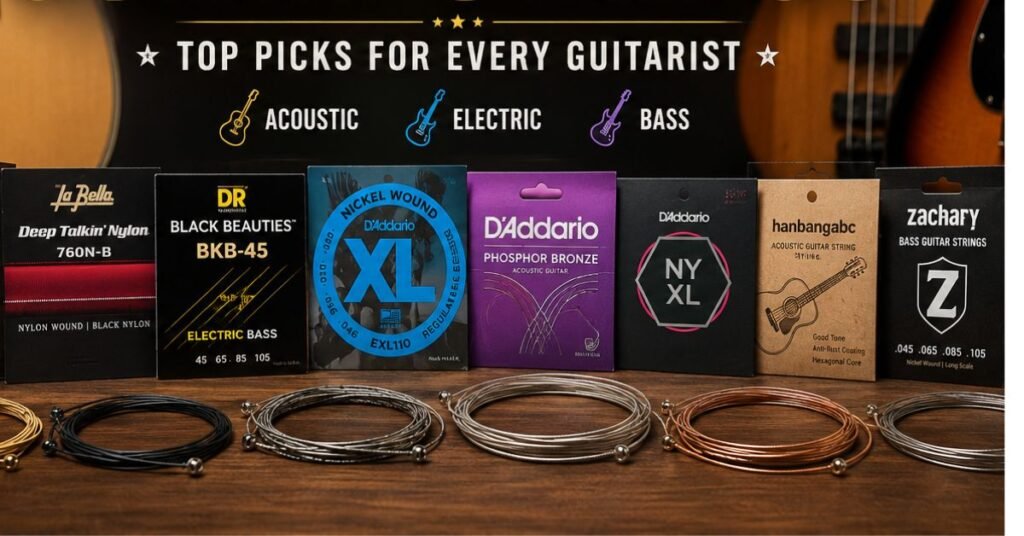
This list brings together 10 options from the supplied product selection, including acoustic, electric, nylon-wound, and bass-oriented strings. Well-known names such as Ernie Ball, La Bella, DR Strings, and D’Addario appear alongside less-specific products where the available product name provides limited technical information.
The goal is not to claim that one set is perfect for everyone. Instead, this guide explains what each option appears best suited for, what to consider before buying, and how to match string type with your instrument and playing style.
Quick Comparison
| Product | Best For | Key Feature | Type | Rating |
|---|---|---|---|---|
| Ernie Ball Light Earthwood Bronze Acoustic Guitar Strings | Acoustic players seeking a bright, balanced sound | 80/20 bronze construction | Acoustic | Not assigned |
| La Bella 760N-B Deep TalkinNylon Wound 5-String | Players needing a nylon-wound 5-string set | Nylon-wound construction | Bass/5-string | Not assigned |
| DR Strings Black Beauties BKB-45 | Players looking for a distinctive string appearance | Black-coated/wrapped design | Bass | Not assigned |
| D’Addario Electric Guitar Strings | Electric guitar players | Established electric-string range | Electric | Not assigned |
| D’Addario Acoustic Guitar Strings | Acoustic guitar players | Multiple acoustic string options | Acoustic | Not assigned |
| D’Addario NYXL1046 Electric Guitar Strings | Electric players prioritizing stability and durability | NYXL technology, 10-46 regular light | Electric | Not assigned |
| hanbangabc Acoustic Guitar String | Budget-conscious acoustic players | Basic acoustic replacement option | Acoustic | Not assigned |
| D’Addario Phosphor Bronze Guitar Strings | Acoustic players wanting warm, balanced tone | Phosphor bronze construction | Acoustic | Not assigned |
| zachary Bass Guitar Strings | Bass players seeking a replacement set | Bass-focused design | Bass | Not assigned |
| Alice Bass String | Bass players looking for another replacement option | Bass-string format | Bass | Not assigned |
Ratings are intentionally not provided because no reliable, comparable rating dataset was supplied.
1. Ernie Ball Light Earthwood Bronze Acoustic Guitar Strings
Ernie Ball’s Earthwood acoustic strings are a strong option for players who want a clear and lively acoustic sound. The Earthwood family includes 80/20 Bronze strings, which Ernie Ball describes as offering a bright, balanced tone with good clarity. The series is available in multiple gauge combinations, allowing players to select a setup that better matches their instrument and playing preferences.
Key Benefits
One of the biggest attractions of an 80/20 bronze acoustic string is its tonal character. Compared with warmer-sounding string formulations, 80/20 bronze is commonly chosen when a guitarist wants more sparkle and clarity from an acoustic instrument.
This makes the Earthwood option particularly interesting for strumming, rhythm playing, songwriting, and situations where the guitar needs to remain articulate in a mix.
Another advantage is the established product range. Rather than being limited to one configuration, Earthwood strings are offered in several combinations, making it easier to select a suitable gauge.
Who It Is Best For
- Acoustic guitarists who prefer bright, clear tones
- Players who enjoy strumming and rhythm work
- Guitarists experimenting with 80/20 bronze strings
- Players who want an established acoustic-string brand
Potential Limitations
The brighter character of 80/20 bronze may not be ideal for every guitar or playing style. Players specifically looking for a warmer or more mellow acoustic sound may prefer phosphor bronze instead.
Pros
- Bright and clear tonal character
- Balanced acoustic response
- Multiple gauge options
- Well-established string family
Cons
- Brightness may not suit every guitar
- Exact gauge should be selected according to the instrument
2. La Bella 760N-B Deep TalkinNylon Wound 5-String
The La Bella 760N-B Deep TalkinNylon Wound 5-String belongs to a very different category from standard six-string acoustic and electric guitar sets. Its name indicates a nylon-wound five-string configuration, making compatibility one of the most important considerations before purchase.
For players whose instruments are designed for this type of string, a specialized set can be preferable to trying to adapt a conventional guitar-string package.
The main point to understand is that string construction affects both feel and sound. Nylon-wound strings can provide a different playing experience from conventional metal-wound strings. They are therefore particularly relevant to players who intentionally want that type of construction rather than simply looking for a general-purpose guitar set.
Who It Is Best For
- Players with compatible five-string instruments
- Musicians specifically seeking nylon-wound strings
- Players interested in a different string feel
- Those who already know the required string configuration
Buying Considerations
Compatibility should come first. Check the instrument’s manufacturer recommendations, scale requirements, bridge design, tuning, and required number of strings before purchasing.
Pros
- Specialized five-string configuration
- Nylon-wound construction
- Suitable for players seeking a different string character
Cons
- Not a universal guitar-string option
- Compatibility needs careful checking
- Less suitable for a standard six-string guitar
3. DR Strings Black Beauties BKB-45
DR Strings Black Beauties BKB-45 stands out primarily because of its distinctive black appearance. For musicians who want their instrument to have a visually different setup, this type of string can provide an alternative to conventional metallic-looking strings.
Appearance is not the only consideration, however. Bass strings need to be selected according to the instrument’s scale, number of strings, tuning, and desired tension. The BKB-45 designation should therefore be checked against the exact requirements of the bass before ordering.
This option may appeal particularly to players who want to combine practical string replacement with a more distinctive instrument aesthetic.
Who It Is Best For
- Bass players interested in a distinctive appearance
- Musicians looking for an alternative string presentation
- Players whose instruments are compatible with the BKB-45 configuration
Buying Considerations
Do not choose this set solely because of its appearance. Confirm the gauge, scale length, number of strings, and compatibility with your bass first.
Pros
- Distinctive visual appearance
- Specialized bass-string option
- Interesting alternative to conventional-looking strings
Cons
- Not intended for standard acoustic or electric guitars
- Exact compatibility must be confirmed
- Appearance should not outweigh gauge and instrument requirements
4. D’Addario Electric Guitar Strings
D’Addario offers a broad range of electric guitar strings, giving players multiple options for different playing styles and setups. Because the supplied product name does not specify a particular D’Addario model, it is best to treat this as a product category rather than assigning specifications to one exact set.
Electric guitar strings can vary significantly in gauge, winding, material, and construction. A lighter set may be attractive to players who prioritize easier bending and a lighter feel, while heavier gauges can offer a different level of resistance and response.
The key advantage of choosing a recognized product family is the ability to select a configuration that matches the guitar rather than settling for a generic string type.
Who It Is Best For
- Electric guitar players
- Beginners learning about different string gauges
- Players replacing strings on a regular basis
- Guitarists who want multiple configuration choices
Buying Considerations
Check the exact model number before purchasing. D’Addario produces many electric sets, so the generic product name alone does not establish a particular gauge or construction.
Pros
- Wide range of electric-string choices
- Established manufacturer
- Suitable for many playing styles
- Multiple gauge options are available across the range
Cons
- Product name is too broad to identify one exact configuration
- Buyers need to verify the specific model
5. D’Addario Acoustic Guitar Strings
D’Addario acoustic guitar strings are another broad category rather than one single product specification. The company produces acoustic strings in different constructions and gauges, including its well-known phosphor bronze range.
This makes D’Addario a practical option for acoustic players who want to experiment with different string characteristics. Depending on the selected model, the player can prioritize brightness, warmth, feel, or a particular tension.
The most important lesson here is that the phrase “D’Addario Acoustic Guitar Strings” is not enough to identify one precise set. Buyers should check the exact model number and gauge listed by the seller.
Who It Is Best For
- Acoustic guitarists
- Players replacing standard acoustic strings
- Beginners comparing different string gauges
- Musicians who want a broad product selection
Pros
- Large acoustic-string selection
- Different gauges and constructions available
- Established manufacturer
- Suitable for many acoustic applications
Cons
- Exact characteristics depend on the specific model
- Generic listings may not provide enough information
6. D’Addario NYXL1046 Electric Guitar Strings
The D’Addario NYXL1046 is one of the most clearly specified products in this list. It is a 10-46 regular-light electric guitar set. D’Addario describes NYXL as a premium uncoated electric string using a NY Steel core, nickel-plated steel wrap wire, and Fusion Twist technology. The company also highlights higher break strength, tuning stability, and an emphasized midrange response compared with its standard strings.
For electric guitarists, the 10-46 configuration is a familiar middle-ground choice. It can work well for players who do not specifically want an ultra-light or heavy setup.
The NYXL range is especially interesting for players who place importance on tuning behavior and string resilience while still wanting an uncoated string.
Who It Is Best For
- Electric guitarists seeking a regular-light setup
- Players who value tuning stability
- Players who want a premium uncoated electric string
- Rock, pop, blues, and general-purpose electric playing
Pros
- Clearly defined 10-46 configuration
- Premium uncoated construction
- Designed for tuning stability
- Designed for increased break strength
- Strong midrange presence
Cons
- May not suit players who prefer very light or heavy gauges
- Premium positioning may not be necessary for every budget
7. hanbangabc Acoustic Guitar String
The hanbangabc Acoustic Guitar String is a less clearly documented option compared with the major-brand products in this list. Because the supplied name does not identify an exact model, gauge, material, or construction, buyers should pay particular attention to the seller’s product specifications before ordering.
For a basic replacement purchase, the most important factors are compatibility and string configuration. An acoustic guitar requires strings appropriate for its design, and choosing the wrong construction or gauge can negatively affect playability and setup.
This type of product may therefore be worth considering when price and basic replacement needs are the priority, but it should be evaluated using the exact listing information rather than assumptions.
Who It Is Best For
- Players seeking a basic acoustic-string replacement
- Budget-conscious buyers
- Guitarists who have confirmed the exact product specifications
Buying Considerations
Verify the number of strings, gauge, material, ball-end configuration, and compatibility with your guitar before purchase.
Pros
- Potentially useful as a basic replacement option
- Suitable for buyers comparing lower-cost choices
- Acoustic-focused product
Cons
- Limited information from the supplied product name
- Exact specifications need verification
- Less established information than major-brand alternatives
8. D’Addario Phosphor Bronze Guitar Strings
D’Addario Phosphor Bronze strings are among the clearest choices in this list for acoustic players who want a balanced and warm tonal character. D’Addario states that it pioneered phosphor bronze acoustic strings in 1974 and describes the series as having a warm, bright, and well-balanced acoustic tone.
The strings use phosphor bronze wrap wire over a high-carbon steel core. D’Addario offers the family in multiple gauges, allowing players to choose between lighter and heavier configurations depending on their guitar and playing style.
This flexibility makes the product useful for a wide range of acoustic players. A lighter configuration may be preferred by someone looking for a more comfortable feel, while a heavier set can provide greater resistance and projection.
Who It Is Best For
- Acoustic guitarists
- Players who prefer warm, balanced tones
- Fingerstyle and strumming players
- Musicians looking for multiple gauge choices
Pros
- Warm and balanced tonal character
- Established phosphor bronze design
- Multiple gauge choices
- Broad acoustic applications
Cons
- Uncoated versions may require regular maintenance
- Heavier gauges can feel more demanding
- Exact characteristics depend on the selected gauge
9. zachary Bass Guitar Strings
The zachary Bass Guitar Strings entry is another product where the supplied name does not provide enough information to identify a specific gauge, scale length, winding type, or exact construction.
That does not automatically make it unsuitable. Bass players often have very specific requirements, however, so compatibility should be the first consideration.
Before buying, check whether the set is designed for the number of strings on the bass, whether its length matches the instrument’s scale, and whether the gauge fits the player’s preferred tension and setup.
For a player simply looking for an alternative bass-string option, this product can be considered alongside other bass sets, but exact specifications should be verified from the individual listing.
Who It Is Best For
- Bass players seeking replacement strings
- Buyers comparing alternative bass-string options
- Players who have confirmed the required specifications
Pros
- Bass-focused product
- Potential replacement option
- Useful for buyers comparing different brands
Cons
- Exact specifications are unclear from the supplied name
- Gauge and scale should be verified
- Limited information makes direct comparison difficult
10. Alice Bass String
Alice Bass String is another bass-oriented option included in the supplied list. Like the previous bass product, the exact model details are important because bass strings are not interchangeable simply based on appearance.
A good bass-string purchase should take into account the instrument’s scale length, number of strings, gauge, tuning, and desired playing feel. If the seller does not clearly state these details, buyers should verify them before ordering.
For musicians who are already familiar with their bass’s required string configuration, Alice can be considered as another option for comparison.
Who It Is Best For
- Bass players looking for replacement strings
- Players comparing alternative bass-string brands
- Buyers who have identified their required gauge and scale
Pros
- Bass-focused option
- Suitable for comparison shopping
- Can serve as a replacement-string candidate
Cons
- Exact model specifications are not provided in the supplied name
- Compatibility needs verification
- Difficult to compare without gauge and construction information
Buying Guide: How to Choose Guitar Strings?
Finding the right strings is less about choosing a universally “best” product and more about matching the strings to your instrument, playing style, and preferred sound.
1. Start With Your Guitar Type
The first question should always be: What instrument are you stringing?
Acoustic guitars generally use acoustic guitar strings, while electric guitars require strings designed for electric pickups and hardware. Bass guitars use substantially different strings because of their longer scale and lower frequencies.
The products in this list demonstrate why this distinction matters. The Earthwood and D’Addario Phosphor Bronze options are acoustic-focused, while NYXL1046 is designed for electric guitar. The La Bella, DR, zachary, and Alice entries are oriented toward specialized or bass applications.
2. Choose the Correct Gauge
Gauge refers to the thickness of the strings.
Common categories include:
- Extra-light
- Light
- Regular
- Medium
- Heavy
Lighter strings can generally feel easier to bend and fret, while heavier strings can provide a firmer feel. However, the best gauge depends on the instrument, tuning, setup, and personal preference.
If you are a beginner, changing dramatically from your guitar’s current gauge may not be necessary. Start with the gauge recommended for your instrument and experiment gradually.
3. Consider String Material
Material has a major influence on acoustic tone.
For example, Ernie Ball Earthwood 80/20 Bronze strings are designed around a bright, balanced character.
D’Addario Phosphor Bronze strings are designed to provide a warm and balanced acoustic sound.
Neither approach is automatically better. The choice depends on the guitar and the sound you prefer.
4. Think About Playing Style
Your playing style should influence your selection.
Strumming
If you spend most of your time strumming chords, clarity and balanced projection may be important.
Fingerstyle
Fingerstyle players may prefer a string combination that provides good note separation and a comfortable feel.
Electric Lead Playing
Electric players who bend frequently may prefer a lighter or regular-light setup.
Heavy Rhythm Playing
Some players prefer greater string resistance and a firmer feel.
5. Check Compatibility
Never purchase strings based solely on the brand name.
Check:
- Number of strings
- Guitar or bass type
- Scale length
- Gauge
- Tuning
- Bridge configuration
- Recommended string type
This is especially important for specialized products such as five-string or bass sets.
6. Decide Between Coated and Uncoated Strings
Coated strings have an additional protective treatment intended to help reduce exposure to contaminants and extend usable life.
Uncoated strings have a more traditional construction and feel.
The D’Addario NYXL1046, for example, is an uncoated electric string. D’Addario specifically positions NYXL as a premium uncoated electric-string range.
7. Consider Your Budget
String replacement is a recurring expense, so value matters.
A premium set may be worthwhile if its characteristics address a specific need, such as tuning stability or preferred tone. However, beginners do not necessarily need the most expensive option.
For less-documented products, compare the exact specifications and seller information carefully before choosing based only on a low price.
8. Think About Maintenance
Even good strings eventually lose their original character.
Simple maintenance can help:
- Wash and dry your hands before playing.
- Wipe strings after playing.
- Keep the instrument in an appropriate environment.
- Replace strings when their tone or playing condition noticeably deteriorates.
D’Addario also recommends wiping strings after use as part of string-care practices.
How to Choose the Best Guitar Strings for Your Needs
There is no single set that works perfectly for every guitarist. Instead, narrow your choice according to your instrument and priorities.
For Beginners
Start with the string type and gauge recommended for your guitar. Avoid making a major change in gauge until you understand how different gauges affect playing feel.
For Acoustic Players
Compare the tonal differences between bronze formulations. Ernie Ball Earthwood 80/20 Bronze is worth considering if you prefer a bright and clear character, while D’Addario Phosphor Bronze is an option for players seeking a warm, balanced acoustic sound.
For Electric Guitarists
The D’Addario NYXL1046 is a clearly specified option for players looking for a regular-light 10-46 electric set with the NYXL construction.
For Bass Players
Prioritize compatibility above everything else. Check the number of strings, scale length, gauge, tuning, and the exact model before purchasing.
For Budget Buyers
Compare the complete specifications rather than choosing only by price. A cheaper set is not necessarily better value if it does not match your instrument.
For Experienced Players
Experienced guitarists can experiment more deliberately with gauge, materials, construction, and tonal characteristics. Changing one factor at a time makes it easier to understand what works best for your setup.
Pros and Cons at a Glance
| Product | Pros | Cons |
|---|---|---|
| Ernie Ball Light Earthwood Bronze | Bright sound, balanced response, established range | May be too bright for some players |
| La Bella 760N-B | Specialized nylon-wound construction, five-string format | Limited compatibility |
| DR Black Beauties BKB-45 | Distinctive appearance, bass-focused | Must verify exact compatibility |
| D’Addario Electric | Broad selection, established brand | Generic name does not identify exact model |
| D’Addario Acoustic | Many acoustic options | Exact characteristics depend on model |
| D’Addario NYXL1046 | 10-46 regular light, tuning-focused design, uncoated | May not suit players wanting very light/heavy gauges |
| hanbangabc Acoustic | Potentially useful basic replacement option | Limited supplied specifications |
| D’Addario Phosphor Bronze | Warm, balanced tone, many gauge options | Uncoated strings require normal maintenance |
| zachary Bass | Bass-focused option | Exact specifications unclear |
| Alice Bass | Bass replacement option | Exact model and gauge need verification |
Frequently Asked Questions
1. What are the best guitar strings for beginners?
There is no universal beginner set. A good starting point is the gauge and string type recommended for your guitar. Lighter or regular-light options can be worth considering if you prefer an easier playing feel.
2. Are acoustic and electric guitar strings interchangeable?
Generally, no. Acoustic and electric guitars are designed around different string types and constructions. Always choose strings intended for your instrument.
3. Are thicker guitar strings better?
Not necessarily. Thicker strings can provide a firmer feel, while thinner strings can feel easier to bend and fret. The right choice depends on your guitar, tuning, technique, and preference.
4. What is the difference between 80/20 bronze and phosphor bronze strings?
80/20 bronze strings are commonly associated with a bright, clear acoustic character. Phosphor bronze strings are commonly chosen for a warmer, balanced sound. Ernie Ball describes its Earthwood 80/20 Bronze strings as bright and balanced, while D’Addario describes its Phosphor Bronze strings as warm, bright, and well balanced.
5. What does 10-46 mean on guitar strings?
10-46 describes the thickness range of a six-string set, from the thinnest string to the thickest. The D’Addario NYXL1046 is a regular-light 10-46 electric guitar set.
6. How often should guitar strings be replaced?
There is no universal schedule. Replacement depends on playing frequency, sweat and environmental conditions, string construction, and personal expectations for tone and feel. Replace them when they noticeably lose their desired sound or playing condition.
7. Should I choose coated or uncoated strings?
Coated strings may appeal to players who want additional protection and potentially longer usable life. Uncoated strings provide a traditional construction and feel. Your choice should depend on playing frequency, feel, tone, and budget.
8. Can I use bass strings on a guitar?
No. Bass strings are designed for bass instruments and should not be treated as interchangeable with standard guitar strings. Always use a string set appropriate for the instrument.
Final Verdict
The Best Guitar Strings depend heavily on the instrument and the player’s priorities. For acoustic players seeking a bright and clear character, the Ernie Ball Light Earthwood Bronze option is a strong candidate, while D’Addario Phosphor Bronze is particularly relevant for players who prefer a warm and balanced acoustic sound.
For electric guitarists, the D’Addario NYXL1046 stands out because its configuration and construction are clearly defined: it is a 10-46 regular-light electric set with NYXL technology designed around tuning stability and durability.
The remaining products are more specialized or less clearly specified from their supplied names, so compatibility should be checked carefully before buying. This is particularly important for five-string and bass products.
Ultimately, the right strings should match your guitar, gauge preference, playing style, desired tone, and budget. Rather than looking for a single winner, use those factors to narrow the list to the set that best fits your particular setup.
