
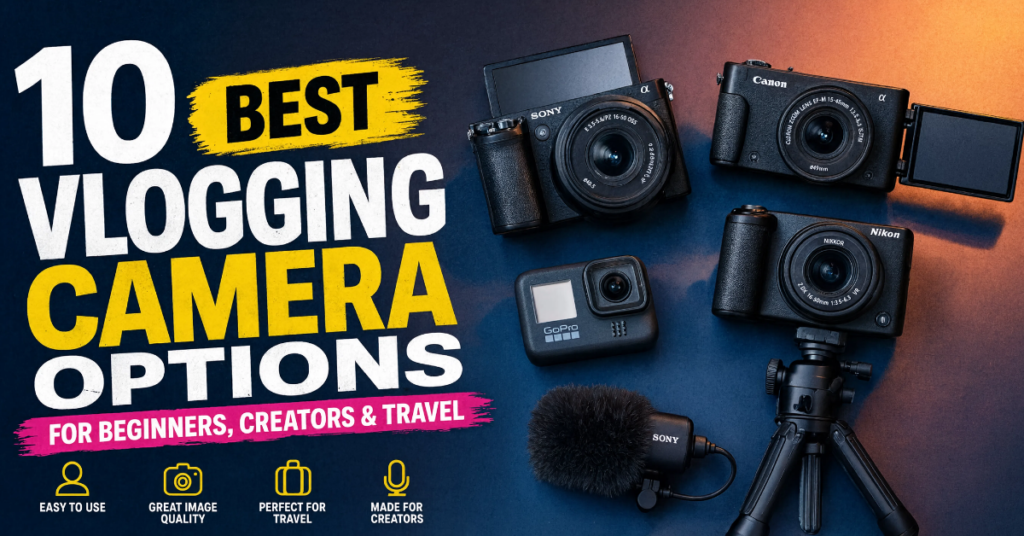
Choosing the Best Vlogging Camera can make content creation much easier, especially when you record yourself, travel frequently, or create videos for YouTube and social media. The right camera should fit the way you actually create content rather than simply having the longest list of specifications.
In this guide, we look at 10 supplied camera options, including the Sony ZV-1F, Sony ZV-1 II, autofocus-focused cameras, anti-shake camcorders, rotatable models, and beginner-friendly options. Because product specifications and availability can vary by seller and version, this guide avoids unsupported claims about prices, ratings, or technical specifications.
Instead, the focus is on practical buying factors such as autofocus, stabilization, portability, usability, self-recording, photography, and overall suitability for different types of vloggers.
Best Vlogging Camera: What Should You Look For?
The best camera for vlogging depends heavily on your content style. A travel creator may prioritize portability and stabilization, while a studio-based YouTuber may care more about autofocus, framing, and audio compatibility. Beginners often benefit from a simple camera that does not require complicated setup.
Before purchasing, consider how you normally record videos. Will you hold the camera while walking? Will you place it on a tripod? Do you frequently record yourself? Do you also take photographs?
Autofocus, stabilization, screen usability, audio options, battery management, portability, and video quality are all important considerations. The goal is not necessarily to find the most expensive camera, but to find a camera that makes your specific workflow easier.
How We Selected These Vlogging Cameras?
The 10 options in this article were selected from the product names supplied for comparison. They represent different approaches to vlogging, including autofocus-oriented cameras, anti-shake camcorders, beginner-focused models, dual-lens designs, rotatable cameras, and Sony’s ZV-series options.
Not every product name provides enough information to verify detailed technical specifications. Therefore, the descriptions below concentrate on the intended use suggested by each product name and on general considerations that shoppers should verify before purchasing.
For branded models such as the Sony ZV-1F and Sony ZV-1 II, buyers should check the current manufacturer’s information and the exact version being sold. For generic names, carefully inspect the seller’s listing for actual specifications, warranty information, included accessories, and supported recording features.
Auto-Focus Vlogging:
An autofocus-oriented vlogging camera can be particularly useful for creators who frequently move toward or away from the camera. Maintaining focus on your face or subject is important when you are recording yourself without someone operating the camera.
This type of camera may appeal to YouTubers, short-form creators, tutorial makers, and people who record talking-head videos. Autofocus can reduce the need to constantly adjust the camera manually, although real-world autofocus performance depends on the specific camera and shooting conditions.
Pros:
- Useful for self-recording
- Convenient for moving subjects
- Can simplify solo content creation
- Helpful for talking-head videos
Cons:
- Autofocus performance varies between models
- Difficult lighting can affect focusing
- Buyers should verify the actual autofocus system
If your content involves frequent movement, autofocus should be one of the first characteristics you investigate.
Xtra Vlogging Kit:
The Xtra Vlogging Kit is presented by name as a solution aimed at vloggers who may want a more complete setup. The word “kit” can be important because creators often need more than the camera itself when beginning a content-creation workflow.
However, buyers should not assume which accessories are included simply from the product name. Check the seller’s package contents carefully. A kit may be attractive when it includes useful accessories, but the value depends on what is actually provided and the quality of those accessories.
For beginners, an all-in-one package can potentially simplify the process of getting started. Instead of purchasing every accessory separately, you can evaluate the complete bundle before deciding.
What to Check?
- Exact camera model
- Included accessories
- Battery and charging equipment
- Mounting accessories
- Microphone or audio accessories
- Warranty and seller support
A kit is worthwhile only when the included items genuinely match your recording needs.
Sony ZV-1F:
The Sony ZV-1F is a well-known model in Sony’s ZV line, which is designed with content creators and vloggers in mind. It can be an interesting choice for creators who want a purpose-oriented camera rather than a traditional photography-first setup.
The ZV-1F is especially relevant when comparing compact cameras for self-recording, travel content, social videos, and YouTube-style production. Before buying, however, shoppers should check Sony’s current product information for the exact specifications, supported features, and compatibility relevant to their workflow.
For someone moving beyond smartphone video, a compact creator-focused camera can provide a more dedicated filming experience. The biggest advantage is often workflow: a camera designed around content creation can feel more natural for people who frequently record themselves.
Pros:
- Creator-oriented product line
- Compact-camera concept
- Suitable for vlogging-oriented workflows
- Strong option to investigate for self-recording
Cons:
- Buyers should compare it with newer alternatives
- Exact specifications should be verified before purchase
- Accessories may increase the overall cost
The ZV-1F deserves consideration when your priority is a compact camera designed around everyday content creation.
Anti-Shake Camcorder
An Anti-Shake Camcorder is naturally appealing to vloggers who record while walking or moving. Camera movement can make footage uncomfortable to watch, particularly during travel videos, outdoor videos, tours, and walking commentary.
Stabilization can help produce smoother footage, but “anti-shake” in a product name should not automatically be treated as proof of a particular stabilization technology or performance level. Buyers should check the actual listing to determine what type of stabilization is provided.
This category may suit creators who spend considerable time filming handheld. It can also be useful for family videos, travel documentation, events, and casual recording.
Pros
- Designed around reducing camera shake
- Potentially useful for handheld filming
- Suitable for walking and travel content
- Simple concept for beginner creators
Cons
- Actual stabilization performance must be verified
- Generic listings can vary significantly
- Image quality may differ considerably between models
If smooth handheld footage is important to you, examine stabilization tests or verified specifications rather than relying only on the product title.
Sony ZV-1 II
The Sony ZV-1 II is another creator-focused option worth considering when researching the best camera for vlogging. As with any specific camera model, the exact features should be confirmed through current manufacturer documentation before purchase.
For vloggers, the important question is how well the camera fits your actual filming style. Consider whether you record indoors, outdoors, while traveling, from a fixed position, or while walking. Also consider whether you need photography capabilities in addition to video.
A dedicated creator camera can be particularly useful for someone who wants to move beyond smartphone recording without immediately moving into a more complex interchangeable-lens system.
Pros
- Designed for the creator market
- Relevant for vlog-focused workflows
- Compact camera category
- Worth comparing with other ZV-series options
Cons
- May not suit every filming style
- Current specifications should be checked
- Total setup cost can depend on accessories
When comparing the ZV-1 II with other cameras, focus on the features that directly affect your content rather than choosing based on model name alone.
Dual-Lens Anti-Shake
The Dual-Lens Anti-Shake option combines two concepts that may interest content creators: dual-lens functionality and stabilization. However, the product name alone does not establish the exact lens configuration, image quality, sensor characteristics, or stabilization system.
This is why checking the full product listing is especially important. Buyers should determine how the two lenses operate, whether they are intended for different shooting perspectives, and whether switching between them is practical.
A dual-lens concept can be interesting for creators who want flexibility without carrying multiple cameras. It could potentially appeal to travel creators and casual videographers who want different perspectives from one device.
Pros
- Dual-lens concept may offer flexibility
- Anti-shake positioning is useful for handheld content
- Potentially convenient for travel
Cons
- Exact lens functionality needs verification
- Product specifications can vary
- Do not assume professional image quality from the name alone
Look beyond the marketing title and examine sample footage, specifications, and user feedback before purchasing.
Rotatable Camcorder
A Rotatable Camcorder may appeal to vloggers who frequently record themselves. A rotating or adjustable camera design can make it easier to position the camera and frame yourself while recording.
This can be useful for creators who work alone. Instead of repeatedly checking whether the camera is pointed correctly, an adjustable design can make positioning more convenient.
The actual mechanism and range of movement vary between products, so shoppers should verify how the camera rotates and whether the screen, lens, or entire camera body is adjustable.
Pros
- Potentially useful for self-recording
- Convenient for flexible camera positioning
- Suitable for solo creators
- Can be helpful when changing shooting angles
Cons
- Rotation mechanism varies by model
- Durability should be considered
- Buyers should inspect the exact design
For solo vloggers, ease of framing can be almost as important as raw image quality.
Beginner Vlogging
A product named Beginner Vlogging is naturally positioned toward people who are starting their content-creation journey. Beginners usually need simplicity more than an overwhelming collection of advanced controls.
A good beginner camera should be straightforward to operate, easy to carry, and practical for everyday filming. Complicated equipment can discourage new creators from recording consistently.
Before purchasing a beginner-oriented camera, look at setup requirements, menu complexity, recording controls, screen visibility, battery management, and available accessories. Also consider whether you expect your content to become more advanced over time.
Pros
- Beginner-focused positioning
- Potentially easier to learn
- Suitable for starting a vlog
- Can be appropriate for casual creators
Cons
- May lack advanced capabilities
- Generic product specifications require careful checking
- Growing creators may eventually want an upgrade
For your first camera, usability is a major advantage. A camera that you actually enjoy using is more valuable than equipment that remains inside a drawer.
5K Digital Camera:
The 5K Digital Camera is positioned around high-resolution video terminology. However, buyers should be careful when interpreting resolution claims. A number in a product name does not automatically guarantee superior image quality.
Real-world video quality depends on multiple factors, including the imaging system, lens, processing, lighting, stabilization, bitrate, autofocus, and recording implementation.
If you are considering a camera because of a “5K” claim, verify the actual supported recording modes and examine sample footage where possible. Also determine whether your editing computer, storage, and publishing platform fit the intended workflow.
Pros
- High-resolution positioning
- Potentially attractive for creators seeking detailed footage
- May appeal to YouTube and travel creators
Cons
- Resolution alone does not determine image quality
- Exact recording specifications must be verified
- Higher-resolution files may require more storage and processing
Do not choose a camera solely because its advertised resolution sounds impressive.
Autofocus Photography:
Autofocus Photography suggests a camera that combines photography-oriented use with autofocus functionality. This may be attractive to creators who want one device for both videos and photographs.
A hybrid workflow can be useful for bloggers, product reviewers, travelers, social-media creators, and small-business owners. Instead of carrying separate devices for still images and video, one camera can potentially handle both tasks.
However, the product name does not tell you enough about actual photography performance. Check the sensor, lens, autofocus behavior, image formats, and other specifications before purchasing.
Pros
- Photography and content creation positioning
- Autofocus can simplify shooting
- Potentially useful as a multipurpose camera
- Suitable for creators who publish photos and videos
Cons
- Exact photography specifications need verification
- Product name alone cannot confirm image quality
- Video capabilities should also be checked
If you create both photographs and videos, a versatile camera may offer better overall value than a video-only solution.
Quick Comparison of the 10 Options:
| Product | Main Positioning | Best For | Important Check |
|---|---|---|---|
| Auto-Focus Vlogging | Autofocus-oriented | Self-recording | Actual AF system |
| Xtra Vlogging Kit | Camera + kit concept | Beginners | Included accessories |
| Sony ZV-1F | Creator-focused compact camera | Vloggers | Current specifications |
| Anti-Shake Camcorder | Stabilization-focused | Walking/travel videos | Stabilization type |
| Sony ZV-1 II | Creator-focused camera | Vloggers/content creators | Current Sony specifications |
| Dual-Lens Anti-Shake | Dual lens + stabilization | Flexible shooting | Lens configuration |
| Rotatable Camcorder | Adjustable/rotatable design | Solo creators | Rotation mechanism |
| Beginner Vlogging | Beginner-oriented | New creators | Ease of use |
| 5K Digital Camera | High-resolution positioning | Resolution-focused buyers | Actual recording modes |
| Autofocus Photography | Photo + autofocus positioning | Hybrid creators | Photo/video specifications |
This table is intended as a starting point rather than a substitute for checking the manufacturer’s or seller’s current specifications.
Best Vlogging Camera for Beginners:
Beginners should usually prioritize ease of use over advanced specifications. When you are learning how to frame shots, record audio, edit footage, and publish consistently, complicated equipment can create unnecessary obstacles.
A beginner-friendly camera should have controls that are easy to understand and a recording workflow that does not require extensive technical knowledge. Autofocus can also be useful because it reduces the amount of manual work involved in self-recording.
Among the supplied options, the Beginner Vlogging model is naturally positioned for new creators, while the Xtra Vlogging Kit may be worth investigating if its included accessories genuinely help you get started.
Sony’s creator-focused options can also be considered by beginners who want a more established camera platform and are comfortable checking their specific requirements before buying.
Best Camera for Travel Vlogging:
Travel vloggers have different requirements from studio creators. When you travel, you may spend hours carrying your camera, walking through busy streets, filming landmarks, recording food, and capturing spontaneous moments.
Portability therefore becomes extremely important. Stabilization can also be valuable because travel footage is often recorded handheld. Autofocus is another useful consideration when you need to react quickly to changing subjects.
An anti-shake camera may appeal to creators who frequently walk while recording. A compact creator camera such as a Sony ZV-series option may also be worth considering when portability and self-recording are priorities.
Before traveling, also think about battery management, storage, charging, weather conditions, and accessories.
Best Camera for YouTube Creators:
YouTube creators should choose a camera based on the type of videos they produce. A talking-head channel has different needs from a travel channel, product-review channel, gaming channel, or outdoor channel.
For stationary videos, reliable autofocus and good framing can be more important than extreme portability. For travel videos, stabilization and size may become more important.
If you record yourself frequently, look for a camera that makes framing straightforward. If you review products, consider how well the autofocus handles your face and the objects you hold toward the camera.
The best YouTube camera is therefore the one that matches your production style, not necessarily the one with the most impressive marketing language.
Why Autofocus Matters for Vlogging?
Autofocus is one of the most useful features for solo vloggers because creators often have nobody behind the camera. You may walk into the frame, hold an object toward the lens, change your position, or move around a room.
Without reliable autofocus, important parts of the video can become soft or out of focus. Manual focusing can work, but it requires more preparation and attention.
When evaluating autofocus, do not rely exclusively on a product description. Look for real-world demonstrations showing face tracking, subject transitions, movement, and different lighting conditions.
A camera with practical autofocus can make content creation significantly easier.
Why Image Stabilization Matters?
Camera shake is especially noticeable in vlogging because creators frequently hold cameras while walking or moving. Even a good-quality camera can produce uncomfortable footage if movement is excessive.
Stabilization can help reduce unwanted motion, but not every stabilization system works the same way. Some cameras may rely on optical, electronic, digital, mechanical, or combined approaches.
When a product is advertised as “anti-shake,” verify exactly what that means. Look for sample footage and official specifications rather than assuming that every anti-shake system provides the same result.
If you primarily use a tripod, stabilization may be less important. If you frequently walk and talk, it becomes much more relevant.
Camera Size and Portability:
A camera that is too large or inconvenient to carry can reduce how often you use it. This is particularly important for travel vloggers and creators who record spontaneous content.
Compact cameras are attractive because they can be easier to carry and set up. A lightweight camera can also be less tiring during long recording sessions.
However, small size should not be the only deciding factor. Make sure the camera still provides the controls, screen arrangement, audio options, and recording capabilities you need.
The ideal balance is a camera that is small enough to carry regularly while still supporting your content-creation workflow.
Audio Considerations for Vloggers:
Good video does not automatically mean good content. Poor audio can make a video difficult to watch, even when the image looks excellent.
When selecting a vlogging camera, investigate its built-in microphone performance and available audio options. Depending on your content, you may eventually want an external microphone.
Outdoor vloggers should pay particular attention to wind and environmental noise. Indoor creators may need to consider room echo and background sounds.
If audio is important to your channel, do not purchase a camera without first confirming how it handles the microphone setup you intend to use.
Video Quality and Recording Needs:
Resolution is only one part of video quality. Lighting, lens performance, image processing, stabilization, autofocus, and recording implementation all influence the final result.
A creator uploading primarily to social media may not need the same recording capabilities as someone producing highly edited long-form videos.
Before choosing a camera, determine where your videos will be published and what resolution you actually need. Also consider your storage capacity and computer performance.
Higher-resolution footage can be useful, but it can also increase file sizes and editing requirements. Choose recording quality based on your workflow rather than selecting the largest number available.
Screen Design and Self-Vlogging
A screen that helps you monitor yourself can be extremely useful when creating videos alone. It allows you to check framing, positioning, and composition before or during recording.
This is particularly important for talking-head videos, travel vlogs, tutorials, and social-media content.
When comparing cameras, inspect how the display works and whether it remains practical when the camera is positioned at different angles. A good self-recording workflow can save time because you spend less effort correcting poorly framed footage later.
For solo creators, usability can have a bigger practical impact than small differences in technical specifications.
How Much Should You Spend on a Vlogging Camera?
There is no universal budget for the best vlogging camera. Your ideal spending level depends on your experience, content goals, existing equipment, and expected publishing frequency.
Beginners should avoid spending heavily on features they do not understand or use. At the same time, buying an extremely basic camera and immediately discovering that it cannot meet your needs can lead to unnecessary replacement costs.
Think about the complete setup rather than only the camera body. You may also need storage, a tripod, microphone, lighting, batteries, carrying equipment, and other accessories.
A balanced setup is usually more useful than putting the entire budget into the camera itself.
Common Vlogging Camera Mistakes to Avoid:
One common mistake is choosing a camera based only on resolution. A larger number does not automatically mean better-looking footage.
Another mistake is ignoring audio. Viewers may forgive moderate image imperfections, but consistently poor sound can quickly become frustrating.
Some buyers also overlook portability. If a camera is difficult to carry, they may stop using it regularly.
Another issue is assuming that a product name confirms a feature. Terms such as “5K,” “anti-shake,” “dual-lens,” or “autofocus” should be followed by a review of the actual specifications.
Finally, avoid buying based solely on a high rating or promotional statement. Check current specifications, warranty coverage, return conditions, sample footage, and reputable user feedback.
How to Choose the Right Vlogging Camera?
Start by identifying your content style. If you mainly create talking-head videos, prioritize autofocus, framing, and audio. If you travel frequently, focus on portability and stabilization.
Next, determine whether you also need photography. If you do, a hybrid camera may make more sense than a device designed primarily for video.
Then consider your experience level. Beginners should look for simple controls and an uncomplicated workflow. More experienced creators may want additional control and flexibility.
Finally, compare the complete cost. Include accessories and storage in your budget.
The right camera should make recording easier, not turn every video into a technical project.
What to Check Before Buying Online?
Online product listings can sometimes use broad marketing language. Always look beyond the title and verify the detailed specifications.
Check the exact model name, manufacturer, included accessories, recording formats, lens information, autofocus capabilities, stabilization system, display design, audio options, battery information, storage compatibility, warranty, and return policy.
For generic cameras, this verification is especially important because similar product names can appear on different listings.
If a specification is not clearly stated, do not assume that the camera supports it. A trustworthy seller should provide enough information for you to make an informed purchase.
Is a Smartphone Still Good for Vlogging?
Yes. Smartphones can be excellent tools for beginners and experienced creators. They are convenient, portable, and usually always available.
A dedicated camera becomes more attractive when you need a specific shooting experience, additional control, specialized features, or a workflow that better suits your content.
You do not need to replace a smartphone simply because dedicated cameras exist. Instead, consider whether a camera would solve a problem that your current device cannot.
For new creators, consistency is often more important than equipment. A simple setup that encourages you to publish regularly can be more valuable than expensive gear that rarely gets used.
Frequently Asked Questions
1. What is the best vlogging camera for beginners?
The best beginner camera is one that is easy to operate, portable, and capable of producing the type of content you want to publish. The Beginner Vlogging and Xtra Vlogging Kit options are worth investigating, while creator-focused cameras such as Sony’s ZV-series models may also suit beginners.
2. Is autofocus important for vlogging?
Yes. Autofocus can be particularly helpful when recording yourself without another person operating the camera. It can reduce the need for manual focusing while you move around or change your position.
3. Is stabilization important for travel vlogging?
Stabilization can be very useful for travel creators because walking and handheld recording can introduce unwanted camera movement. However, the quality of stabilization varies, so check the actual system and real-world footage.
4. Is a 5K camera automatically better?
No. Resolution is only one factor in image quality. Lens performance, sensor technology, processing, stabilization, autofocus, lighting, and recording implementation also matter.
5. Should beginners buy an expensive vlogging camera?
Not necessarily. Beginners should prioritize usability and the features they actually need. Spending more only makes sense when the additional capabilities provide a meaningful benefit to your content.
6. Is Sony ZV-1F good for vlogging?
The Sony ZV-1F is a creator-focused model and is therefore relevant to vloggers researching compact cameras. Before purchasing, check Sony’s current specifications and compare the model with your specific filming requirements.
7. Is Sony ZV-1 II suitable for YouTube?
The Sony ZV-1 II is positioned within Sony’s creator-focused ZV line, making it a model worth considering for YouTube content. Your final decision should depend on your preferred shooting style and the current specifications.
8. Do I need a camera with a rotating screen for vlogging?
A rotating or adjustable display can be useful when you record yourself because it can make framing easier. It is helpful but not essential if you have another reliable way to monitor composition.
9. Should I buy a camcorder or compact camera for vlogging?
It depends on your workflow. A camcorder-style design may appeal to people who prioritize straightforward handheld recording, while a compact creator camera may be more attractive to vloggers who value portability and a dedicated content-creation design.
10. What is more important: video resolution or autofocus?
Both matter, but the priority depends on your content. For solo vloggers, reliable autofocus can make a major practical difference. Resolution matters too, but it should not be evaluated in isolation.
11. Can one camera be used for both photography and vlogging?
Yes, depending on the model. A camera positioned for autofocus photography may be attractive to creators who want to capture both still photographs and video. Always check the actual photo and video capabilities before purchasing.
Final Verdict: Which Is the Best Vlogging Camera?
There is no single camera that is perfect for every creator. The Best Vlogging Camera is ultimately the one that matches your recording style, budget, experience level, and publishing needs.
If autofocus is your priority, an autofocus-oriented option deserves attention. If you frequently walk while recording, an anti-shake model may be more practical. If you want a creator-focused compact camera, the Sony ZV-1F and Sony ZV-1 II are important models to compare. Beginners may prefer a simpler option or a package that includes useful accessories.
The most important lesson is to avoid choosing a camera based on a single marketing term. “5K,” “anti-shake,” “dual-lens,” and “autofocus” can all sound impressive, but their real value depends on how those features are implemented.
Before purchasing, verify the exact specifications, included accessories, warranty, current price, and seller information. Think about how you will actually use the camera—not just how impressive the product page looks.
For a new creator, a camera that is easy to carry, simple to operate, and reliable enough to encourage regular filming can be a much better investment than an unnecessarily complicated setup. For experienced creators, the priority should be finding the combination of autofocus, stabilization, image quality, audio support, portability, and workflow flexibility that best fits their channel.
In short, choose the camera that helps you create more consistently and confidently. The best equipment is the equipment that makes you want to pick it up, press record, and tell your story.
Previous Others Article:
10 Best Electric Guitar Options
